





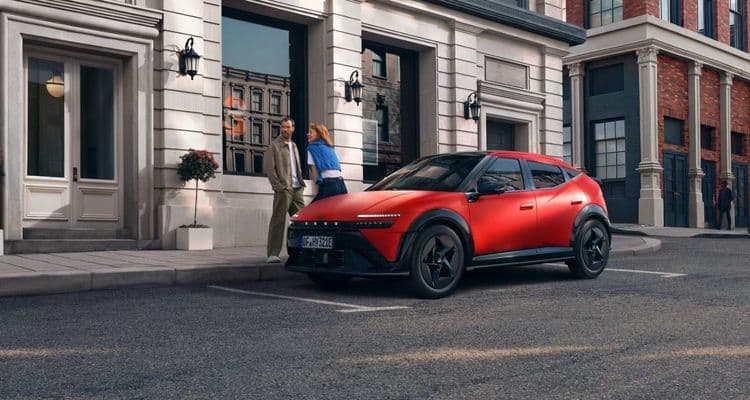
The Hyundai IONIQ 3 – the all-electric city SUV
Hyundai IONIQ 3 N Line, 61 kWh battery, automatic transmission, front-wheel drive, 99 kW (135 PS): combined energy consumption: 15.10 kWh/100 km, combined CO₂ emissions: 0 g/km, CO₂ class: A I.



Hyundai IONIQ 3 N Line, 61 kWh battery, automatic transmission, front-wheel drive, 99 kW (135 PS): combined energy consumption: 15.10 kWh/100 km, combined CO₂ emissions: 0 g/km, CO₂ class: A I.



Model highlights
It’s designed to be compact without feeling cramped. At just over four metres in length, the Hyundai IONIQ 3 remains easy to handle, yet thanks to its Aero-Hatch design, it offers space for five people and a generous boot capacity. This marks the IONIQ family’s first entry into the compact class – fully electric, available in five trim levels ranging from Select to N Line Evo, and available to order now. What sets it apart is the cosy interior, the distinctive look of the N Line, bold colour options and technology such as the new Pleos Connect infotainment system. The following sections explain this in more detail. If you have any questions about a particular specification, please feel free to contact us – we’ll be happy to advise you personally.

Interior
Inside, Hyundai has adopted the ‘Furnished Space’ concept, in which controls and storage compartments are arranged more like furniture than traditional vehicle fittings. This creates a calm atmosphere and plenty of room to move around for five people. A flat floor and the long wheelbase of 2,680 mm provide generous legroom and headroom, even in the rear. A handy feature is the Megabox, an additional 119-litre storage compartment beneath the boot floor, on top of the standard boot capacity of 441 litres. In the Prime and N Line Evo trim levels,acoustic laminated glass¹
in the front and side windows further ensures a quieter cabin. The optionalSeating Package¹
adds a relaxation function and ventilation for the driver’s and front passenger’s seats, as well as heated rear seats – comfort features more commonly found in mid-range and luxury cars.
N Line
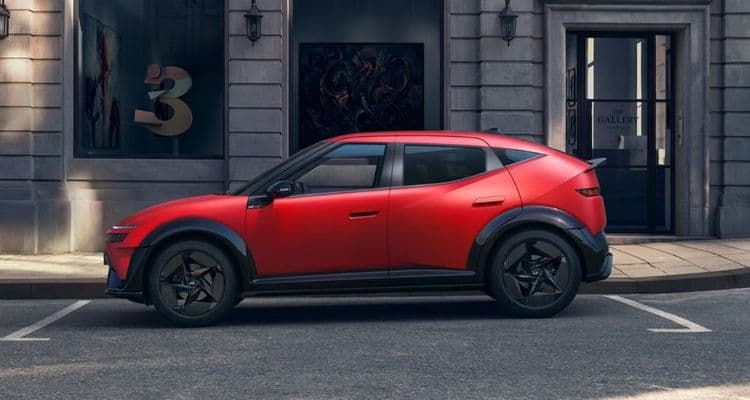
The IONIQ 3 N Line has a slightly sportier look. Black body kits, a black Hyundai logo and 18-inch alloy wheels are the first design highlights on the exterior; the N Line Evo features 19-inch wheels. Inside, the seat upholstery – a combination of fabric and velour with red decorative stitching – and aluminium-look pedals create a distinctive, more dynamic look. The IONIQ 3 N Line Evo also featuresMatrix LED headlights¹
, a BOSEsound system¹
and Active SoundDesign¹
.
Colours
With the Hyundai IONIQ 3, you can choose from eight exterior paint finishes. Fierce Red is available as a solid colour as standard, alongside AtlasWhite1
(also a solid colour) and the metallic shades LumenGrey1
, PhantomBlack1
, AuroraGrey1
, IceBlue1
and VibrantBlue1
. FierceRed1
is also available in a matt finish, although not for the Select trim level. For the interior, Hyundai combines fabric upholstery in the Select and Trend trims with fabric velour in the N Line, N Line Evo and Prime trims. Black comes as standard, whilstBeige1
(Trend) orLight Blue1
(Prime) are available as options; the N Line features black with red decorative stitching.
Vehicle-to-Loadfunction 1
The Hyundai IONIQ 3 can not only charge its own battery but also supply power to other devices. Thanks toVehicle-to-Load technology¹
, electrical devices can be powered via the integrated 230-volt socket or the external charging port. This feature is included inthe
optionalTechnology Package¹
, which also upgrades the on-board charger to 22 kW AC.
Trim levels and prices
Enquire about the Hyundai IONIQ 3
The Hyundai IONIQ 3 launch
Parts & Accessories
With us you are in the best hands when it comes to spare parts and accessories. With our extensive range, we offer you the highest standards and best quality.
Buy directly online now!
Features
Infotainment & Connectivity
With Pleos Connect, Hyundai is introducing a completely new generation of in-car systems for the IONIQ 3, which is no longer based on the previous ccNC system used in the IONIQ 5, IONIQ 6 and IONIQ 9, but on Android Automotive OS. A dedicated Pleos App Market for third-party apps, automatic over-the-air updates and the AI-powered voice assistant Gleo AI deliver a user experience that is closer to that of a smartphone than a traditional in-car computer. A new feature is the screen layout. The main screen, measuring 12.9 inches (Select, Trend) or 14.6 inches (N Line, Prime, N Line Evo), handles almost all functions, whilst the optional Digital Cockpit – available from the Trend trim level upwards – measures just 250 by 30 millimetres despite its 9.9-inch screen diagonal. It displays the most important driving information as a narrow strip below the windscreen. Plug & Charge assists with charging without the need for an additional app; anavigation system¹
comes as standard from the N Line trim level upwards and is available as an option in the Navigation Pack on the Trend trim. In the Prime and N Line Evo trims, the Digital Car Key 2.0 (UWB) is also fitted as standard.
Assistance & Safety
When it comes to driver assistance systems, the IONIQ 3 features Hyundai Smart Sense. Standard features include Autonomous Emergency Braking 2.0 (FCA 2.0), Lane Following Assist (LFA), Adaptive Cruise Control with Stop function (ASCC) and Blind-Spot Collision Avoidance Assist (BCA). From the N Line trim level upwards, the range includes Highway Driving Assist 2.0 (HDA 2.0) with hand detection, a 360-degree camera (SVM), the Blind-Spot View Monitor (BVM), the Manoeuvring Assist (MRA) and the Remote-controlled Parking Assist 1.0 (RSPA 1.0). Seven airbags are standard across the range. The new MRA Reversing Assistant is particularly useful when reversing through narrow streets or alleys. It memorises up to 50 metres of the route previously travelled forwards at speeds below 30 km/h and, when reversing at speeds below 10 km/h, automatically steers along this path whilst you control the accelerator and brakes yourself. It is activated via a button on the display as soon as the vehicle is stationary and reverse gear is engaged.
Up to 8 years of worry-free motoring**
Hyundai IONIQ 3 Warranty
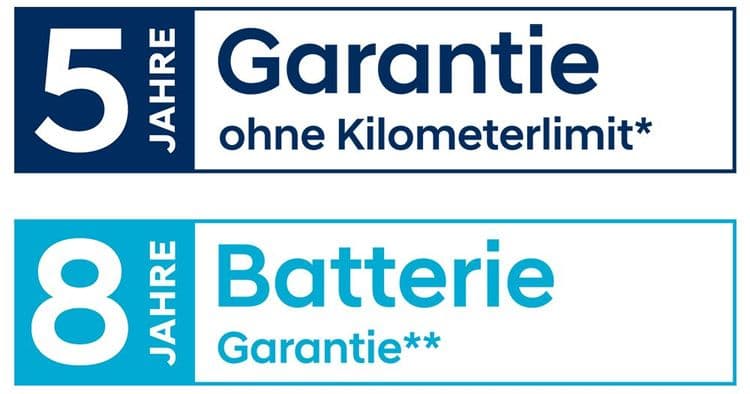
Like all Hyundai electric models, the IONIQ 3 comes with comprehensive cover. You benefit from a 5-year vehicle warranty* with no mileage limit, as well as an 8-year warranty** on the high-voltage battery (up to 160,000 km, whichever comes first). This ensures you’re covered for many years to come.
Technical details of the IONIQ 3
Battery and range
How far can the Hyundai IONIQ 3 travel on a full charge? There are two battery options to choose from. TheStandard Range version20
has a battery capacity of 42 kWh and, depending on the trim level, achieves a WLTP range of up to 344km10
. With the61-kWh battery²¹
, the Long Range version achieves a WLTP range of up to 497km¹⁰
, depending on the trim level. The two variants differ not only in capacity but also in cell chemistry. The 42 kWh battery uses LFP (lithium iron phosphate) cells, whilst the 61 kWh battery uses NMC (nickel-manganese-cobalt) cells.
Powertrain & Performance
The Hyundai IONIQ 3 is based on the Hyundai Motor Group’s Electric Global Modular Platform and utilises a 400-volt architecture. Both battery variants feature front-wheel drive. The Standard Range version delivers 108 kW (147 PS) and accelerates from 0 to 100 km/h in 8.7 seconds. The Long Range version delivers 99 kW (135 PS) and takes 9.5 seconds to reach 100 km/h; in the N Line and N Line Evo variants, this takes 9.6 seconds. The top speed is 170 km/h, rising to 171 km/h for the N Line Evo.
Charging
At a DC fast-charging station, the Hyundai IONIQ 3 charges from 10 per cent to 80per cent
in around 29 minutes (Standard Range, up to 119 kW) or 30 minutes (Long Range, up to 110 kW)¹¹
. AC charging at 11 kW is available as standard when using a suitable wallbox. As an option, the Hyundai IONIQ 3 supports AC charging power of up to 22 kW when fitted withthe Technology Pack¹
.
Dimensions & Weight
Thanks to its raised seating position and SUV design, the Hyundai IONIQ 3 appears larger from the outside than it actually is. At 4,155 mm in length in the base version and 4,170 mm in the N Line and N Line Evo variants, it is shorter than a VW Golf (4,282 mm) and around 20 centimetres shorter than a VW T-Roc (4,372 mm). The SUV is 1,800 mm wide, 1,505 mm high (N Line/N Line Evo: 1,510 mm) and has a wheelbase of 2,680 mm. The wheelbase, in particular, is above average. It is longer than that of the Golf, the T-Roc and even the larger Hyundai KONA Electric. This is the real reason for the generous amount of space in the interior, which the compact exterior dimensions do not suggest at first glance. The boot offers 441 litres of storage space, 119 litres of which are in the handy Megabox beneath the boot floor; with the rear seats folded down, capacity increases to up to 1,213 litres. Depending on the model, the kerb weight ranges from 1,625 to 1,735 kg. The drag coefficient is 0.263.
| Motorisation | Performance | Drive type | Torque | 0–100 km/h | Maximum speed | WLTP range¹⁰ | Charging time: 10–80%¹¹ | Boot capacity |
|---|---|---|---|---|---|---|---|---|
| 42 kWh | 108 kW (135 PS) | Front-wheel drive | 250 Nm | 8.7 s | 170 km/h | Up to 344 km | approx. 29 min | 441 l |
| 61 kWh | 99 kW (135 PS) | Front-wheel drive | 250 Nm | 9.5 s | 170 km/h | Up to 497 km | approx. 30 min | 441 l |
Performance
108 kW (135 PS)
Drive type
Front-wheel drive
Torque
0–100 km/h
Maximum speed
WLTP range¹⁰
Charging time: 10–80%¹¹
Boot capacity
441 l
Performance
99 kW (135 PS)
Drive type
Front-wheel drive
Torque
0–100 km/h
Maximum speed
WLTP range¹⁰
Charging time: 10–80%¹¹
Boot capacity
441 l
Frequently Asked Questions about the Hyundai IONIQ 3
Wann kann ich den Hyundai IONIQ 3 bestellen?
Ja, der Hyundai IONIQ 3 ist ab sofort bestellbar. Die Lieferzeit für eine individuelle Neufahrzeugbestellung liegt aktuell bei etwa 4 bis 7 Monaten. Gern beraten wir Sie zu aktuell verfügbaren Fahrzeugen.
Was kostet der Hyundai IONIQ 3?
Der Einstieg beginnt bei 28.950 €3 für die Linie Select, die sportliche N Line Evo startet bei 42.450 €7. Zu aktuellen Konditionen und verfügbaren Fahrzeugen beraten wir Sie gern persönlich.
Welche Reichweite hat der IONIQ 3?
Je nach Batterie und Ausstattungslinie liegt die Reichweite nach WLTP10 bei bis zu 344 km mit der 42-kWh-Batterie beziehungsweise bis zu 497 km mit der 61-kWh-Batterie.
Wie groß ist der Kofferraum?
441 Liter, davon 119 Liter in der praktischen Megabox unter dem Kofferraumboden. Bei umgeklappter Rückbank wachsen bis zu 1.213 Liter.
Welche Farben gibt es für den IONIQ 3?
Acht Außenfarben stehen zur Wahl, darunter Fierce Red, Atlas White, Phantom Black1, Lumen Grey1, Aurora Grey1, Ice Blue1, Vibrant Blue1 und Fierce Red Matt1. Dazu kommen mehrere Innenraumwelten, inklusive einer eigenen N-Line-Variante mit roten Ziernähten1.
Wie schnell lädt der IONIQ 3?
Am DC-Schnelllader lädt die Standard-Range-Version (bis 119 kW) in rund 29 Minuten, die Long-Range-Version (bis 110 kW) in rund 30 Minuten von 10 auf 80 Prozent11. Per Wechselstrom sind serienmäßig 11 kW möglich, optional bis zu 22 kW1.
Was ist die IONIQ 3 N Line?
Eine sportlichere Ausstattungslinie mit eigenständigen Designakzenten außen und innen, darunter größere Leichtmetallfelgen, schwarze Anbauteile und eine Sitzpolsterung mit roten Ziernähten. Die N Line Evo ergänzt zusätzlich Matrix-LED-Scheinwerfer und ein BOSE Soundsystem.
Ist der IONIQ 3 ein SUV?
Hyundai selbst bezeichnet ihn als Aero Hatch, also als vollelektrischen Kompaktwagen mit besonders windschnittiger Form. Von der erhöhten Sitzposition und dem Auftritt her passt aber auch die Bezeichnung City-SUV gut.
Kann ich die Warntöne im Hyundai IONIQ 3 abschalten?
Ausgewählte akustische Warnungen für Geschwindigkeitsüberschreitung und Unaufmerksamkeit lassen sich stummschalten. Dazu halten Sie die Tempolimit-Taste am Lenkrad während der Fahrt gedrückt und wählen im Menü die gewünschten Warntöne aus. Aus gesetzlichen Gründen aktiviert sich die Warnfunktion bei jedem Fahrzeugstart automatisch neu.
Wie groß ist der Hyundai IONIQ 3 im Vergleich zu anderen Fahrzeugen?
Mit 4.155 bis 4.170 mm Länge ist der IONIQ 3 kürzer als ein VW Golf (4.282 mm) und deutlich kürzer als ein VW T-Roc (4.372 mm), auch wenn die erhöhte Sitzposition ihn optisch größer wirken lässt. Seinen Radstand von 2.680 mm übertrifft dagegen sogar der größere Hyundai KONA Elektro nicht, das erklärt das großzügige Platzangebot im Innenraum.

Half and annual cars
Everything under one roof
35 years of experience
Um diesen Inhalt anzeigen zu können, ist Ihre Zustimmung erforderlich.
* Ohne Aufpreis und ohne Kilometerlimit: die Hyundai Herstellergarantie mit 5 Jahren Fahrzeuggarantie (3 Jahre für serienmäßiges Car-Audio-Gerät inkl. Navigation bzw. Multimedia sowie für Typ-2-Ladekabel (je nach Ausstattung) und 2 Jahre für die Bordnetzbatterie), 5 Jahren Lackgarantie sowie 2 Jahren Mobilitätsgarantie mit kostenlosem Pannen- und Abschleppdienst (ab dem 3. Jahr gelten die Bedingungen der Langzeit-Mobilitätsgarantie). 5 kostenlose Sicherheits-Checks in den ersten 5 Jahren gemäß Hyundai Sicherheits-Check-Heft. Mehr unter: www.hyundai.de/garantien
Die 5-jährige Herstellergarantie für das Fahrzeug gilt nur, wenn dieses ursprünglich von einem autorisierten Hyundai Vertragshändler an einen Endkunden verkauft wurde.
Für Taxis und Mietwagen gelten generell abweichende Regelungen gemäß den Bedingungen des Garantie- und Servicehefts.
** Garantie für die Hochvolt-Batterie für alle wasserstoff-/batterieelektrischen sowie Hybrid- und Plug-in-Hybrid-Modelle: 8 Jahre oder bis zu 160.000 km, je nachdem, was zuerst eintritt. Mehr unter: www.hyundai.de/garantien
Für Taxis und Mietwagen gelten generell abweichende Regelungen gemäß den Bedingungen des Garantie- und Servicehefts.
1 Optional, aufpreispflichtige Zusatzausstattung
3 Unverbindliche Preisempfehlungen der Hyundai Motor Deutschland GmbH, Kaiserleipromenade 5, 63067 Offenbach, jeweils zzgl. Überführungskosten, nur bei teilnehmenden Hyundai Händlern, Preis auf Anfrage und nur solange der Vorrat reicht: Hyundai IONIQ 3 Select und Trend mit 42 kWh Batterie, 108 kW (147 PS), Frontantrieb; Hyundai IONIQ 3 N Line, Prime und N Line Evo mit 61 kWh Batterie, 99 kW (135 PS), Frontantrieb.
10 Maximale Reichweite nach WLTP. Die tatsächliche Reichweite wird von verschiedenen Faktoren beeinflusst z. B. von Verkehrsbedingungen, Fahrzeugausstattungen und Fahrweise. Im realen Fahrbetrieb kommt es zu einer geringeren Reichweite.
11 Entsprechende Hochleistungs-Ladepunkte vorausgesetzt, kann die Hochvoltbatterie in nur 29 Minuten von 10 % auf 80 % geladen werden. Die Ladezeiten können variieren – in Abhängigkeit von den örtlichen Ladebedingungen (z. B. Art und Zustand der Ladesäule, Batterietemperatur oder Umgebungstemperatur).
20 Hyundai IONIQ 3 108 kW (147 PS) Batterie 42 kWh: Energieverbrauch kombiniert: 14,1–14,4 kWh/100 km; CO₂-Emissionen kombiniert: 0 g/km; CO₂-Klasse: A. Elektrische Reichweite bei voller Batterie nach WLTP: bis zu 344 km.
21 Hyundai IONIQ 3 99 kW (135 PS) Batterie 61 kWh: Energieverbrauch kombiniert: 13,7–15,8 kWh/100 km; CO₂-Emissionen kombiniert: 0 g/km; CO₂-Klasse: A. Elektrische Reichweite bei voller Batterie nach WLTP: bis zu 497 km.
© 2026 CSB Schimmel Automobile GmbH. All rights reserved.

Die Setzung einiger Cookies ist zwingend erforderlich. Für bestimmte Dienste benötigen wir Ihre Einwilligung.
Durch den Klick auf „Alle Cookies akzeptieren“, willigen Sie (jederzeit für die Zukunft widerruflich) in alle Datenverarbeitungen (Setzung von Cookies und Übermittlung der IP-Adresse an Partner) ein.
Durch den Klick „ Alle optionalen Cookies ablehnen“ werden alle nicht zwingend notwendigen Cookies nicht gesetzt und Verbindungen unterbunden. Die Nutzung unserer Webseite ist dann stark eingeschränkt.
Durch den Klick auf „ Lassen Sie mich wählen“ können Einstellungen geändert und der Datenverarbeitung eingewilligt werden. Ihre Auswahl kann jederzeit angepasst werden.
Hinweis auf Verarbeitung der Daten in den USA (z.B. durch Google, Facebook, Youtube): Durch den Klick auf „Alle Cookies akzeptieren" oder bei der entsprechenden Auswahl eines Anbieters, willigen Sie zugleich darin ein, dass Ihre Daten in den USA verarbeitet werden. Die USA wird als ein Land mit einem nicht ausreichenden Datenschutzniveau angesehen. Es besteht u.a. das Risiko, dass Ihre Daten durch US-Behörden, zu Kontroll- und zu Überwachungszwecken, möglicherweise auch ohne Rechtsbehelfsmöglichkeiten, verarbeitet werden können. Bei dem Klick auf „Alle optionalen Cookies ablehnen“, findet keine Datenübermittlung statt.
Weitere Informationen finden Sie unter Datenschutz. Zum Impressum.