





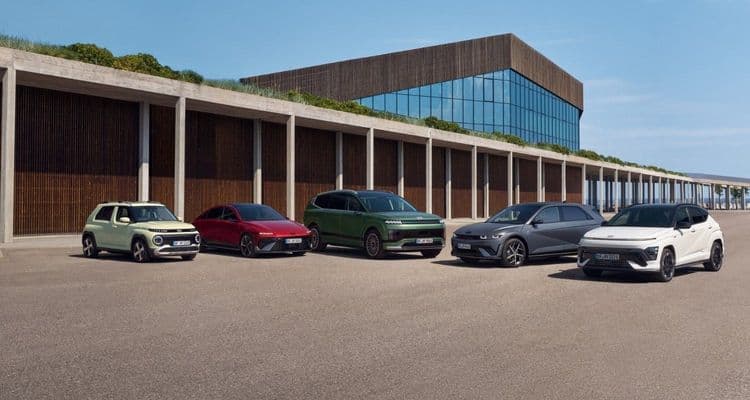
E-car subsidy 2026: Current grants & benefits
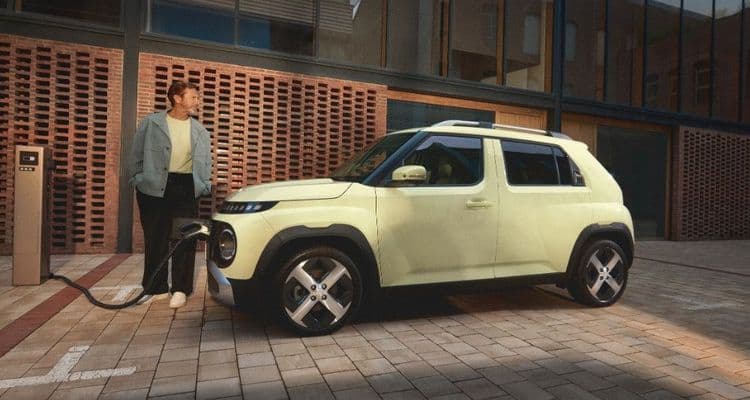
Hyundai INSTER, 49 kWh battery 85 kW (115 PS), automatic, front-wheel drive: combined energy consumption: 15.10 kWh/100 km, combined CO2 emissions: 0 g/km, CO2 class: A; Hyundai IONIQ 9, 110 kWh battery 315 kW (428 PS), automatic, all-wheel drive Performance: combined energy consumption: 20.60 kWh/100 km, CO2 emissions combined: 0 g/km, CO2 class: A; Hyundai IONIQ 6 N Line X, 84 kWh battery 239 kW (325 PS), automatic, all-wheel drive: energy consumption combined: 15.90 kWh/100 km, CO2 emissions combined: 0 g/km, CO2 class: A; Hyundai IONIQ 5 N Line X, 84 kWh battery 239 kW (325 PS), automatic, all-wheel drive: energy consumption combined: 18.10 kWh/100 km, combined CO2 emissions: 0 g/km, CO2 class: A; Hyundai KONA Elektro N Line X, 65 kWh battery 150 kW (204 PS), automatic, front-wheel drive: combined energy consumption: 16.30 kWh/100 km, combined CO2 emissions: 0 g/km, CO2 class: A I.



Hyundai INSTER, 49 kWh battery 85 kW (115 PS), automatic, front-wheel drive: combined energy consumption: 15.10 kWh/100 km, combined CO2 emissions: 0 g/km, CO2 class: A; Hyundai IONIQ 9, 110 kWh battery 315 kW (428 PS), automatic, all-wheel drive Performance: combined energy consumption: 20.60 kWh/100 km, CO2 emissions combined: 0 g/km, CO2 class: A; Hyundai IONIQ 6 N Line X, 84 kWh battery 239 kW (325 PS), automatic, all-wheel drive: energy consumption combined: 15.90 kWh/100 km, CO2 emissions combined: 0 g/km, CO2 class: A; Hyundai IONIQ 5 N Line X, 84 kWh battery 239 kW (325 PS), automatic, all-wheel drive: energy consumption combined: 18.10 kWh/100 km, combined CO2 emissions: 0 g/km, CO2 class: A; Hyundai KONA Elektro N Line X, 65 kWh battery 150 kW (204 PS), automatic, front-wheel drive: combined energy consumption: 16.30 kWh/100 km, combined CO2 emissions: 0 g/km, CO2 class: A I.



The German government has decided to once again provide financial support for private households switching to electromobility from 2026. Following the expiry of the environmental bonus at the end of 2023, this marks the return of a state purchase premium that is specifically aimed at families and households with low and medium incomes. The new Electric Mobility 2026 funding programme provides a total of three billion euros from the Climate and Transformation Fund (KTF), which can be drawn down until 2029. At CSB Schimmel Automobile in Berlin, we can provide you with comprehensive advice on how to obtain the maximum 2026 electric car subsidy for your new vehicle.
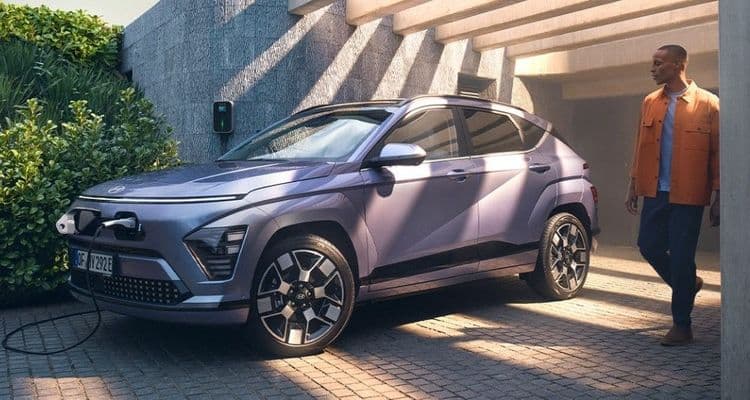
E-car offers with subsidies
No vehicles found.
At a glance: The most important facts about the new electric car subsidy
- Up to €6,000 state e-car premium
- Only for private individuals with a taxable household income of up to €80,000
- An income limit of up to €90,000 applies for households with children
- BAFA e-car subsidy: Application after vehicle registration via the Federal Office
- Eligible for funding: New cars (BEV and plug-in hybrids) in vehicle class M1
- Programme start: As soon as possible (subject to EU approval), probably from May 2026
- The application can probably be submitted retroactively from May 2026 for eligible vehicles with first registration from 1 January 2026
- Leased vehicles are also eligible if they are registered to the lessee
- The vehicle must be held for at least 36 months after initial registration
State e-car premium 2026 in detail
The new funding programme of the Federal Ministry for the Environment, Climate Protection, Nature Conservation and Nuclear Safety (BMUKN) is expected to start in 2026. The 2026 electric car subsidy programme is still subject to approval by the European Commission under state aid law. Unlike previous programmes, the current funding is based on a combination of a basic premium and individual social components, which means that the subsidy varies depending on personal circumstances.
Basic subsidy and electric car subsidy 2026
Depending on the size of your household, income and the type of vehicle you choose, you can receive a grant of between €1,500 and €6,000. Only private individuals with an annual taxable income of up to €80,000 for the entire household are eligible. For each child in the household, this income limit increases by €5,000 to a maximum of €90,000. Within the income limits, the basic subsidy for purely electric cars is €3,000. Eligible plug-in hybrids are subsidised with at least €1,500. The application is processed by the Federal Office of Economics and Export Control (BAFA), although the application can also be submitted after the vehicle has been registered. The vehicle must also have been registered for the first time on 1 January 2026 or later.
Additional bonuses for families and low incomes
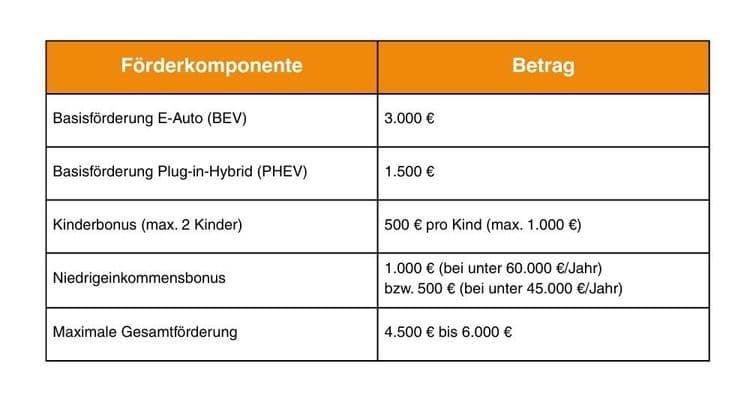
The Electric Mobility 2026 funding programme takes greater account of personal circumstances. Families with children will be subsidised more and receive an additional €500 each for the first two children - the subsidy amount increases to €4,000 for e-cars and €2,500 for plug-in hybrids. If your household income is less than €60,000 per year, you can increase the subsidy by an additional €1,000. If the annual income is less than €45,000, the top-up is even €2,000.
What is the taxable income?
The taxable income is not your gross salary, but your gross income minus all legally permitted deductions. The state takes into account various expenses that are deducted from your gross income either automatically or on application. These include, for example, social security contributions, private pension provision, travel costs to work (commuter allowance), child allowances, donations and much more.
The connection with your tax return:
It is precisely these deductions that are claimed on your annual income tax return. The tax office uses this to calculate your taxable income and determines how much tax you actually have to pay. If you have paid too much income tax during the year, you will be refunded the difference. This value, the taxable income, is stated in your tax assessment notice and is decisive for the e-car subsidy.
Where can I find my taxable income?
You can find your taxable income in your income tax assessment notice from the tax office. The relevant value is usually on the first page in the section "Calculation of taxable income".
Important for couples:
The household income counts for the subsidy. If you live with a partner (married, in a registered civil partnership or in a marriage-like relationship), both incomes are added together.
How to find the value:
- Joint tax assessment: The combined taxable income of both partners is stated directly in the assessment - this value applies.
- Separate tax assessment notices: Add up the two taxable incomes from your respective tax assessment notices yourself.
Funding overview at a glance
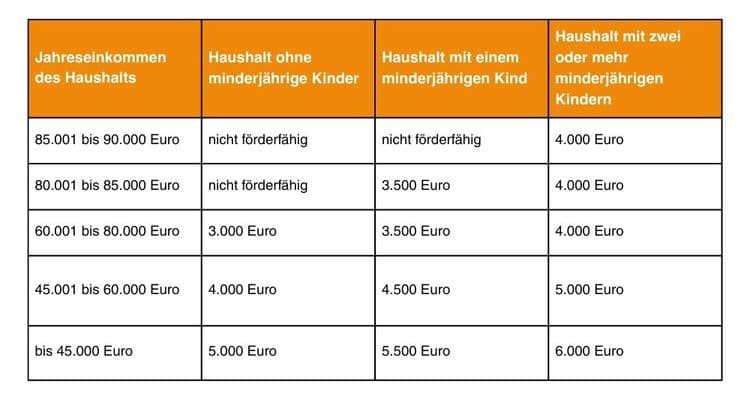
The amount of your personal subsidy depends on your household income, the number of children you have and the type of vehicle. The graphic shows you an overview of all possible combinations:
Overview of subsidies for purely battery-electric cars
With an annual income of up to 45,000 euros:
- Without minor children: 5,000 euros
- With one minor child: 5,500 euros
- With two or more minor children: 6,000 euros
With an annual income of 45,001 to 60,000 euros:
- Without minor children: 4,000 euros
- With one minor child: 4,500 euros
- With two or more minor children: 5,000 euros
With an annual income of 60,001 to 80,000 euros:
- Without minor children: 3,000 euros
- With one minor child: 3,500 euros
- With two or more minor children: 4,000 euros
With an annual income of 80,001 to 85,000 euros:
- Without minor children: not eligible
- With one minor child: 3,500 euros
- With two or more minor children: 4,000 euros
With an annual income of 85,001 to 90,000 euros:
- Without minor children: not eligible
- With one minor child: not eligible
- With two or more minor children: 4,000 euros
Funding for eligible plug-in hybrids (PHEV) or electric vehicles with range extender (REEV)
Plug-in hybrids (PHEVs) and electric cars with range extenders can be subsidised from 1 January 2026 to 30 June 2027. A minimum electric range of 80 kilometres or CO₂ emissions of no more than 60 grams of CO₂ per kilometre are required.
The amount of the subsidy depends on your annual income and the number of underage children in your household.
With an annual income of up to 45,000 euros:
- Without minor children: 3,500 euros
- With one minor child: 4,000 euros
- With two or more minor children: 4,500 euros
With an annual income of 45,001 to 60,000 euros:
- Without minor children: 2,500 euros
- With one minor child: 3,000 euros
- With two or more minor children: 3,500 euros
With an annual income of 60,001 to 80,000 euros:
- Without minor children: 1,500 euros
- With one minor child: 2,000 euros
- With two or more minor children: 2,500 euros
With an annual income of 80,001 to 85,000 euros:
- Without minor children: not eligible
- With one minor child: 2,000 euros
- With two or more minor children: 2,500 euros
With an annual income of 85,001 to 90,000 euros:
- Without minor children: not eligible
- With one minor child: not eligible
- With two or more minor children: 2,500 euros
Plug-in hybrids (PHEVs) and electric cars with range extenders can be subsidised until 30 June 2027. Prerequisite: at least 80 km electric range or a maximum of 60 g CO₂/km. The funding amount is between €1,500 and €4,500.
Services and advice at Schimmel Automobile
We take time for your individual mobility planning. Transparency and fair conditions are a matter of course for us. We will provide you with a detailed list of all price advantages so that you can always keep an eye on the savings when buying or leasing. A personal contact person will accompany you from the initial consultation to the delivery of your new electric car.
Tax advantages & GHG quota
Company car taxation: The 0.25 per cent rule
Electric mobility is particularly attractive for commercial customers. Since 1 July 2026, an increased price limit for tax incentives for electric company cars has applied. Pure electric vehicles with a gross list price of up to €100,000 (previously €70,000) can be taxed at the reduced rate of 0.25 per cent of the gross list price. The 0.5 per cent rule applies to e-cars with a list price of over €100,000. Compared to combustion engines, which are taxed at 1 per cent, this means a considerable monthly reduction in tax.
The 0.5% rule also applies to plug-in hybrids, provided the vehicle either has a minimum electric range of 80 kilometres or emits no more than 50 grams of CO₂ per kilometre. Companies also benefit from a new special depreciation allowance for electrically powered vehicles purchased between July 2025 and December 2027.
Annual premium through the GHG quota
In addition to the one-off purchase premium, as the owner of an all-electric car you can benefit from the annual greenhouse gas reduction quota (GHG quota). The GHG bonus for 2026 is currently between €200 and €300, depending on the provider. Some providers offer guaranteed premiums of up to €285. This premium is completely tax-free for private individuals.
The application process is straightforward: simply upload a photo of your vehicle registration certificate (registration certificate part I) to the provider of your choice. The submission deadline for the 2026 quota year ends on 31 October 2026. We will be happy to show you how you can have your CO₂ savings certified and thus secure an annual payout.
Eligible vehicles
The new subsidy for electric cars applies to new cars of the EU vehicle class M1 with a purely battery electric drive (BEV) or plug-in hybrid drive (PHEV) registered in Germany for the first time as well as to electric vehicles with a range extender (REEV). According to the current status of the Federal Ministry for the Environment, there are no restrictions on the list price of vehicles.
This means that numerous vehicles from our range are also eligible for the subsidy. This includes these models, among others:
- Hyundai INSTER
- Hyundai KONA electric
- Hyundai IONIQ 5
- Hyundai IONIQ 6
- Mitsubishi Outlander
- Mitsubishi Eclipse Cross Electric
These plug-in hybrids, for example, are also eligible:
Hyundai TUCSON 1.6 GDI PHEV 2WD, range: 86 to 89 km, CO₂: 62 to 65 g (MY25/2620
Hyundai TUCSON 1.6 GDI PHEV 4WD, range 61 to 65 km, CO₂: 26 to 30 g (MY25)21
Hyundai SANTA FE 1.6T-GDI PHEV 4WD, range 54 km, CO₂: 38 g (MY25)22
Mitsubishi Outlander PHEV 4WD, range 83 to 85 km, CO₂: 19 g (MY25/26)23
We will be happy to advise you on which other vehicles from our Hyundai, Mitsubishi and MAXUS brands are eligible. As things currently stand, used cars are not part of the subsidy programme starting in 2026, but are being reviewed by the Federal Ministry for the Environment.
Make an appointment now at one of our four locations in Berlin
Would you like to know more about how much your personal subsidy will be in 2026? Please visit us at one of our locations in Berlin and Brandenburg. We will work with you to check the eligibility of your desired model and support you with all the formalities. As soon as BAFA activates the digital application portal, we will guide you through the entire application process.
Frequently asked questions about the 2026 e-car subsidy
When will the new e-car subsidy start in 2026?
The Electric Mobility 2026 funding programme will start as soon as possible after approval by the EU Commission. The funding will apply retroactively from 1 January 2026 and applications can be submitted online via the BAFA portal.
How do I apply for the BAFA e-car subsidy?
After registering the vehicle, you submit the application to BAFA. The purchase contract, registration certificate and proof of income are required. The 2026 electric car subsidy will be paid out retroactively.
Which vehicles are eligible for the Electric Mobility 2026 funding programme?
New vehicles in the M1 vehicle class with battery electric drive (BEV) registered for the first time and, under certain conditions, plug-in hybrids (PHEV) and electric vehicles with range extenders (REEV) are eligible. A list price cap of €100,000 currently only applies to company cars that are also used privately. Used cars are excluded from the subsidy.
Who is eligible for the 2026 electric car subsidy?
Private individuals with a taxable household income of up to €80,000 (plus €5,000 per child up to a maximum of €90,000). Commercial buyers are excluded, but benefit from the 0.25 per cent company car scheme.
For more information, simply arrange your consultation online or contact us by phone - we look forward to hearing from you!
Note: The information in this text is correct as of January 2026. The final design of the funding programme is still subject to approval by the European Commission. Details on the application process and deadlines will be published by BAFA as soon as the programme starts.

Half and annual cars
Everything under one roof
35 years of experience
Um diesen Inhalt anzeigen zu können, ist Ihre Zustimmung erforderlich.
20 Hyundai TUCSON Plug-in-Hybrid 132 kW (180 PS), 1.6 T-GDI PHEV 6-Gang-A/T, Automatik, Frontantrieb: Energieverbrauch kombiniert/gewichtet: 2.8 l/100 km, Energieverbrauch kombiniert/gewichtet: 10.90 kWh/100 km, CO2-Emissionen kombiniert/gewichtet: 64 g/km, CO2-Klasse: B; Kraftstoffverbrauch bei entladener Batterie kombiniert: Energieverbrauch kombiniert: 6 l/100 km, CO2-Emissionen kombiniert: 137 g/km, CO2-Klasse: E
21 Hyundai TUCSON Plug-in-Hybrid 212 kW (288 PS), 1.6 T-GDI PHEV 6-Gang-A/T, Automatik, Allradantrieb: Energieverbrauch kombiniert/gewichtet: 3.2 l/100 km, Energieverbrauch kombiniert/gewichtet: 11.10 kWh/100 km, CO2-Emissionen kombiniert/gewichtet: 72 g/km, CO2-Klasse: B; Kraftstoffverbrauch bei entladener Batterie kombiniert: Energieverbrauch kombiniert: 6.5 l/100 km, CO2-Emissionen kombiniert: 147 g/km, CO2-Klasse: E
22Hyundai SANTA FE Plug-in-Hybrid 212 kW (288 PS), 1.6 T-GDI PHEV 6-Gang-A/T, Automatik, Allradantrieb: Energieverbrauch kombiniert/gewichtet: 3.8 l/100 km, Energieverbrauch kombiniert/gewichtet: 11.40 kWh/100 km, CO2-Emissionen kombiniert/gewichtet: 87 g/km, CO2-Klasse: B; Energieverbrauch bei entladener Batterie: Energieverbrauch kombiniert: 7.1 l/100 km, CO2-Emissionen kombiniert: 162 g/km, CO2-Klasse: F
23 Outlander Plug-in Hybrid Diamant 2.4 Benziner 100 kW (136 PS) 4WD, Elektromotoren vorn 85 kW (116 PS) / hinten 100 kW (136 PS), Systemleistung 225 kW (306 PS) Energieverbrauch 24,8 kWh/100 km Strom & 2,7 l/100 km Benzin; CO₂-Emission 60 g/km; CO₂-Klasse B; gewichtet kombinierte Werte. Bei entladener Batterie: Energieverbrauch 6,8 l/100km Benzin; CO₂-Klasse E; kombinierte Werte.

© 2026 CSB Schimmel Automobile GmbH. All rights reserved.

Die Setzung einiger Cookies ist zwingend erforderlich. Für bestimmte Dienste benötigen wir Ihre Einwilligung.
Durch den Klick auf „Alle Cookies akzeptieren“, willigen Sie (jederzeit für die Zukunft widerruflich) in alle Datenverarbeitungen (Setzung von Cookies und Übermittlung der IP-Adresse an Partner) ein.
Durch den Klick „ Alle optionalen Cookies ablehnen“ werden alle nicht zwingend notwendigen Cookies nicht gesetzt und Verbindungen unterbunden. Die Nutzung unserer Webseite ist dann stark eingeschränkt.
Durch den Klick auf „ Lassen Sie mich wählen“ können Einstellungen geändert und der Datenverarbeitung eingewilligt werden. Ihre Auswahl kann jederzeit angepasst werden.
Hinweis auf Verarbeitung der Daten in den USA (z.B. durch Google, Facebook, Youtube): Durch den Klick auf „Alle Cookies akzeptieren" oder bei der entsprechenden Auswahl eines Anbieters, willigen Sie zugleich darin ein, dass Ihre Daten in den USA verarbeitet werden. Die USA wird als ein Land mit einem nicht ausreichenden Datenschutzniveau angesehen. Es besteht u.a. das Risiko, dass Ihre Daten durch US-Behörden, zu Kontroll- und zu Überwachungszwecken, möglicherweise auch ohne Rechtsbehelfsmöglichkeiten, verarbeitet werden können. Bei dem Klick auf „Alle optionalen Cookies ablehnen“, findet keine Datenübermittlung statt.
Weitere Informationen finden Sie unter Datenschutz. Zum Impressum.